

A Magician Posing As a Writer
When I read Murakami, I feel as though something in my mind opens up, as if he’s shifted the walls of my imagination. In his books, reality is never fixed, but instead resembles a thin and permeable boundary that barely separates one world from another.
In The City and Its Uncertain Walls, that boundary disappears entirely. A young man enters a walled city that feels more real than the world he has left behind. At its gate, a mysterious Gatekeeper removes his shadow, which is the condition for remaining within the city. From that moment on, he exists in two incomplete forms, divided between worlds.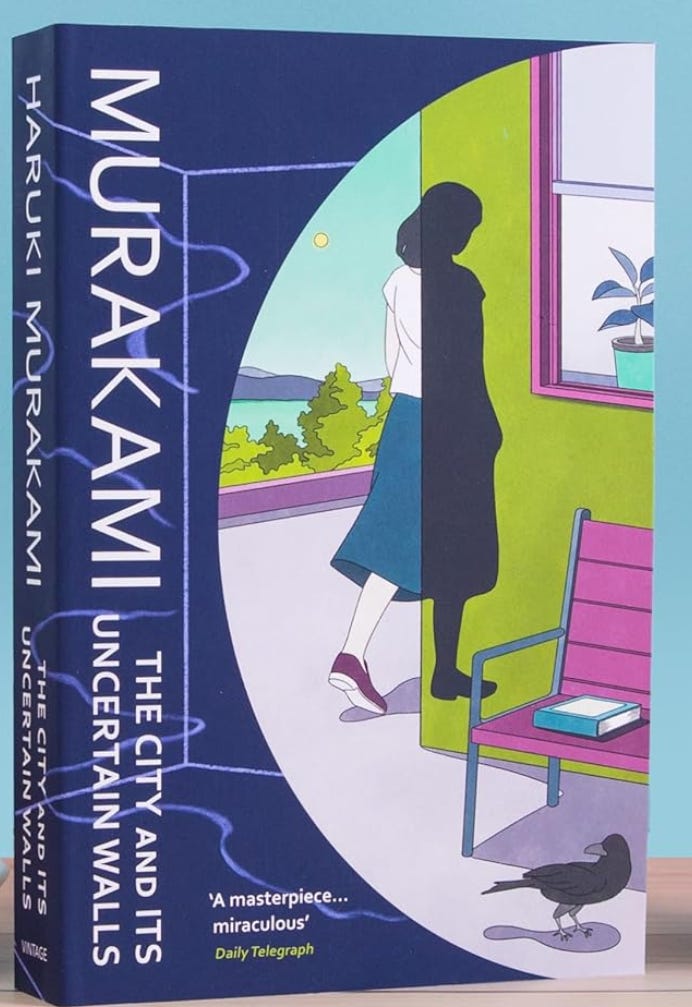
The city is not simply a symbol for grief or longing, but their physical expression, made solid and structural. By using this metaphor, Murakami asks what it means for a place to be real and whether the inner worlds we build from love, loss, and years of quiet reading might constitute a truer reality than the physical one we inhabit and can be located on a map.
Murakami writes with remarkable clarity and simplicity, yet the effect is dreamlike. He does not explain the city with its uncertain walls, where time stands still and emotions lie dormant. He just show us its quiet strangeness. There is a river to cross, unicorns that arrive each evening, and a library where instead of books it holds dreams stored in skulls. He isn’t interested in making you understand, choosing instead to describe feelings, the way memory does.
What remains is a question about consciousness and identity. The protagonist’s shadow, severed and exiled from the walled city, continues to exist in the ordinary world. But which version of the shelf is more real and which of them is haunting whom?
Murakami does not offer explanations, and this silence is exactly what makes the novel so powerful. The uncertainty is not a failure of imagination but its most honest expression, a reminder that every life contains a place it cannot leave, and a self it cannot fully recover.
The novel blends everyday realism with dreams, where time, memory, trauma and desire fold into one another. It’s an intense work that demands attention an a willingness to let oneself suspend between worlds, shaped by silence and absence. It’s a book for readers who understand that some of the most lasting questions in literature are often the ones that remain unanswered.
Thanks for reading Chronicles of a Liquid Society! This post is public so feel free to share it.
✍️ Written by

Newsletter
Stay updated with new articles.
No comments yet. Be the first to comment!