

Greece Beyond Recovery
I recently spent several weeks in Greece. Although I have lived abroad for decades, I try to follow the developments in my home country as closely as I can. But being there offered something statistics, reports and headlines never quite manage to capture: everyday conversations. I spoke with people across generations and professions, and, most importantly, with those living far from Athens, workers in small businesses, farmers and retirees in small towns and villages whose names rarely appear in ministerial speeches. Their lives differ, but their concerns converge around the same themes, life has become expensive, wages remain stubbornly low, and the state appears curiously selective in its efficiency, punctual when it comes to collecting taxes but absent in its duties, acting as though everyday hardship were someone else’s problem.
At some point, usually between coffee and complaint, the same question surfaced, if the economy is truly improving, why does daily life keep getting harder for so many people? What exactly does recovery mean if it cannot be translated into affordability, security, or at least the modest illusion of dignity. Growth for many people is an abstract concept. Bills are painfully real.
These voices stand in stark contrast to the dominant international narrative about Greece. In recent years, Greece has been widely portrayed as a success story of economic recovery after an unprecedented sovereign debt crisis. Fiscal discipline has been restored, access to financial markets has been returned, and public debt ratios are gradually declining. From Brussels to Frankfurt, Greece is no longer cited as a warning but as an example of successful adjustment. On paper, the country appears to have turned a corner.
Yet beneath this image of stability lies a more uncomfortable reality: the structural foundations of the Greek economy remain largely unchanged. The country has learned to live with its weaknesses rather than resolve them. Two indicators, in particular, capture this contradiction: the chronic trade deficit and the still-massive public debt. While neither is, in isolation, evidence of imminent crisis, together they reveal a political economy that has prioritised stabilisation over transformation. Greece has learned how to manage its imbalances, but not how to eliminate their root causes.
The Deficit We Learned to Ignore
The government treats the trade deficit as a background statistic rather than a strategic threat, preferring to manage appearances rather than face the structural dependence it exposes (see numbers at footnotes).[1] Greece imports far more than it exports, not because of temporary shocks or excessive consumption, but because of the way its economy produces, or more accurately, what it fails to produce. Energy imports dominate, followed by machinery, vehicles and a wide range of industrial inputs that are not luxuries, but the basic materials the economy cannot function without.
Exports, meanwhile, remain concentrated in a narrow range of sectors, such as agri-food products, pharmaceuticals, basic materials, and refined fuels. Even there, much of the value added relies on imported components. Growth does not reduce this dependence; it often intensifies it as rising consumption pulls imports upward faster than exports can respond. During economic expansions, imports surge and the deficit widens, while during downturns it narrows only because demand collapses. Therefore adjustment comes through exhaustion, not reform. Greece’s trade deficit is structural, not behavioural.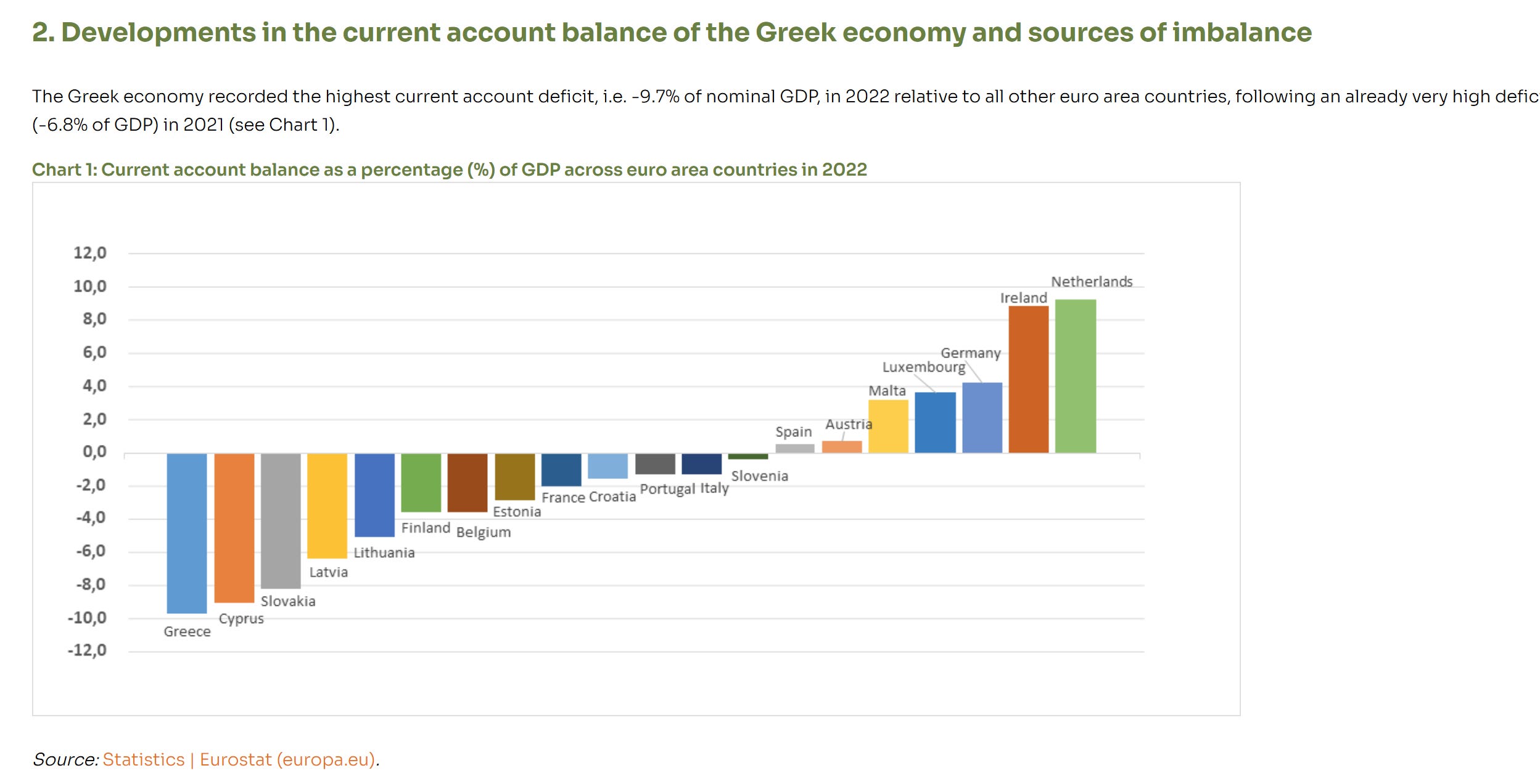
The causes are well known, yet persistently under-addressed.
First, is the productive structure itself. Greece never developed a strong base in technologically advanced manufacturing capable of producing capital goods at scale, leaving it dependant on imported machinery and limiting its export capacity.
Second, energy dependence. As a net importer of fossil fuels, Greece remains exposed to global price shocks, which pass straight through the trade balance into household bills.
Third,the fragmentation of the business sector. The Greek economy is dominated by small and micro enterprises. While flexible, they struggle to achieve economies of scale, invest in innovation, or integrate into global value chains. Export success exists, but as an exception rather than the rule.
Fourth, the model of consumption-led growth. For decades, Greek growth relied disproportionately on domestic consumption, often financed by borrowing, rather than productivity. This has been a political and economic choice repeated across governments with predictably similar results.
Is a trade deficit, in itself, a problem? Not necessarily. Many advanced economies sustain deficits while maintaining productive economies and high living standards. What matters is how those deficits are financed. Greece partially offsets its trade deficit through services, primarily tourism and shipping. These sectors generate foreign exchange and help stabilise the current account. However, reliance on services brings its own vulnerabilities, as tourism is sensitive to geopolitics, pandemics, and climate pressures, and shipping revenues fluctuate with global trade conditions. Neither sector generates the kind of deep domestic supply chains that sustain long‑term competitiveness. And when deficits are financed through debt or asset sales rather than productivity, fragility follows, as Greece discovered painfully in late 2009.
The Art of Appearing Reformed
Greece’s public debt remains among the highest in the world as a share of GDP, despite its restructuring and gradual decline in recent years (see footnote). [2] Politically, this enables the comforting language of “Greece’s restoration as a credible borrower.” Yet in absolute terms, debt levels remain extraordinarily high, limiting fiscal policy and constraining the state’s capacity to absorb shocks or pursue large-scale industrial strategies. Debt sustainability today depends less on numbers than on continued market confidence, compliance with fiscal rules, and alignment with European economic governance, leaving little room for policy experimentation. Transformation is postponed in favour of reassurance.
To be fair, things have changed. Renewable energy capacity has expanded, parts of the state function better than before, and infrastructure has improved. But these advances remain fragmented. Greece still lacks a coherent, industrial strategy that that survives electoral cycles, and targets a limited number of sectors with scale, export potential, and domestic value creation. Infrastructure projects are great, but infrastructure alone does not rewrite a productive model, unless embedded within broader systems of urban planning, incentives, skills development, and industrial policy. Otherwise, it risks becoming another Greek habit, impressive projects without systemic consequences.
Entrepreneurship data reinforce this impression. Recent figures from the General Commercial Registry (GEMI) , presented by the journalist Dimitra Manifava, in the newspaper Kathimerini, show an economy active but stuck in “low flight.” New businesses proliferate, but mostly in low value-added services. Delivery platforms explode, Airbnb rentals colonise urban housing and restaurants open and close with remarkable speed. I don’t think I’ve seen another major city with as many cafés and coffee shops as Athens. Employment is sustained, but productivity is not. GDP per hour worked is just over halfof the EU average. The economy moves, but does not climb.
And people notice. And they leave.
A report by Maria Sideri in the newspaper Vimashows that one in ten households now has at least one member abroad, a figure that is likely higher if entire households are counted. This is not just about unemployment. It’s about suffocation. Wages lag behind living costs. Meritocracy feels conditional. Stability feels temporary. Those who leave are typically skilled, mobile, and of working age, deepening the country’s demographic challenge.
Those few who return do not necessarily find relief. Surveys among returnees paint a sobering picture: health, education, living standards, governance - all rated mediocre at best. Return, it seems, is an emotional decision. Staying requires structural reasons.
There are, nevertheless, reasons for cautious optimism. In 2025, the European Investment Bank (EIB) financed a record €3.5 billion in Greece, focusing on energy, infrastructure, strategic raw materials, and business expansion. These are not cosmetic investments. Grid interconnections reduce energy dependence. SME financing can shift capital away from speculative activity and toward productive investment. The development of domestic production of bauxite and gallium has the potential to link Greece to European supply chains, albeit with substantial and well-documented environmental costs.
The technical solutions exist and they are extensively mapped across peer reviewed research, EU policy frameworks, and established industry practice. The challenge, therefore, is not one of knowledge but of execution. Without strategy, continuity of reform, and institutions that reward scale, exports, and innovation, even well-intentioned investment risks becoming another missed opportunity - producing isolated success stories rather than systemic change.
Greece stands, as often does, at a familiar crossroads. It has a right to be proud of what has been achieved, and it knows all too well how much it cost its people. Now it faces a choice: it can continue managing its imbalances with discipline and patience, stable enough to avoid crisis but too constrained to truly converge. Or it can attempt something harder. Redesign its productive core.
History suggests Greeks are remarkably skilled at survival. The unanswered question is whether they are prepared, politically and collectively, to choose change before necessity forces it upon them.
Thanks for reading Chronicles of a Liquid Society! This post is public so feel free to share it.
Footnotes:
[1] Recent figures show Greece running multi‑billion‑euro monthly and annual deficits:
- December 2025: €3.6 billion deficit, the largest since 2022
- January–July 2025: €19.48 billion deficit in just seven months
- 2024 full year: €34.6 billion deficit, up from €32.07 billion in 2023
[2] Greece’s 2026 budget projects debt falling to 137.6% of GDP, explicitly described as a return to 2009 levels, the year before the bailout era began. https://greekreporter.com/2025/10/11/greek-public-debt-levels/
Sources:
- https://tradingeconomics.com/greece/balance-of-trade
- https://www.ot.gr/2025/02/08/english-edition/greek-trade-deficit-surges-to-e34-6-billion-in-2024-amid-export-decline/
- https://www.naftemporiki.gr/english/2001632/trade-deficit-at-19-48-billion-in-7-months-5-3-drop-in-exports/
- SUERF - The European Money and Finance Forum
- Assessing the Impact of Trade Barriers on Energy Use in Turbulent Times: Current Conditions and Future Outlook for Greece
- https://greekreporter.com/2025/10/11/greek-public-debt-levels/
- Greece Faces $1.32 Billion Deficit as Imports Outpace Exports - GreekReporter.com
- https://en.protothema.gr/2025/10/06/bloomberg-greek-debt-at-16-year-low-historic-decline-after-a-decade-of-bailouts-chart/
- https://www.kathimerini.gr/economy/564066376/apo-tin-oikonomia-toy-kafe-se-aytin-toy-delivery/
- https://www.ekathimerini.com/economy/1254841/greek-labor-productivity-remains-low/
- https://www.tovima.gr/2026/02/10/finance/brain-drain-ekriktiki-ayksisi-ena-sta-10-noikokyria-apoxairetise-melos-tou/
- https://www.ot.gr/2025/02/08/english-edition/greek-trade-deficit-surges-to-e34-6-billion-in-2024-amid-export-decline/
- https://www.naftemporiki.gr/english/2059473/metlen-eib-backs-europes-first-gallium-production-investment-with-90-million-financing/
- https://www.miningsee.eu/greece-at-the-crossroads-how-bauxite-nickel-and-esg-pressures-are-shaping-europes-southern-strategic-minerals-powerhouse/
- https://elkamehr.com/en/the-carbon-cost-of-bauxite-mining-mitigation-strategies/
- https://www.tovima.gr/2026/02/03/finance/vroxi-ependyseon-apo-tin-etep-35-dis-eyro-stin-elliniki-oikonomia/
✍️ Written by

Newsletter
Stay updated with new articles.
No comments yet. Be the first to comment!