

How To Spot A Fascist
It has become increasingly difficult to ignore the political turmoil that characterises public life on both sides of the Atlantic. Democracy still exists in theory, but its practical function in countries such as the United States and even the United Kingdom feels increasingly fragile. Over the past several months, I have been trying to answer a troubling question. Are we still living in functioning democracies, and do the institutions that once supported them still carry out their purpose.
Among the books and articles I read during this period, Umberto Eco’sHow To Spot a Fascist stood out. Eco warns us that fascism is not a relic of the past but a recurring temptation, a set of psychological and cultural patterns that can reappear in new guises whenever societies grow fearful, polarised, or nostalgic for an imagined age of certainty. To recognise a fascist is not simply to identify a Mussolini or a Hitler, but to recognise the patterns of thought and rhetoric that slowly erode democracy from within. Eco’s list of recurring symptoms felt disturbingly relevant as I considered current events in the United States.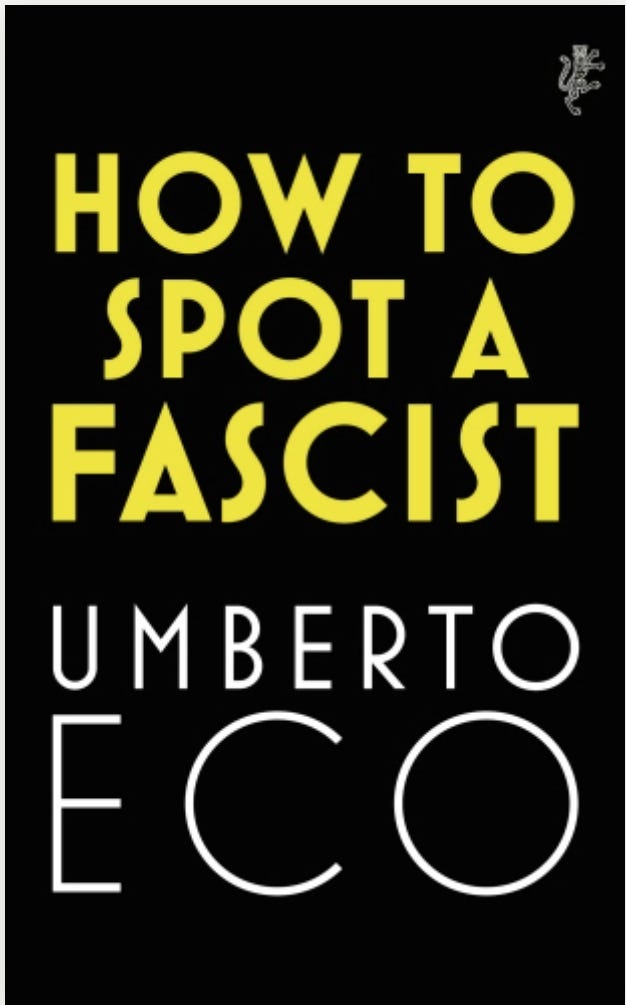
- Tradition is weaponised as truth
Traditionalism is older than fascism. It can be traced to the late Hellenic period as a reaction to the classical Greek rationality of Socrates, Plato and Aristotle. Socrates was condemned for “impiety” and for corrupting the youth because his rational questioning seemed to threaten traditional religious beliefs. Traditionalists believe that the original texts contain grains of wisdom hidden beneath allegory. As a result, there can be no advancement of learning. Look at the foundational texts of every fascist movement and you will find traditionalist thinkers who promote inherited wisdom above the possibility of discovery. - Traditionalism implies a rejection of modernism
Both the fascists and the Nazis celebrated technology and industrial achievement, but their praise of modernity was superficial. The Enlightenment and the Age of Reason were not seen as triumphs of human thought but as the beginning of moral decay. Something similar can be seen in the United States today. Scientific thinking is treated with suspicion, even as technological innovation is celebrated. In this sense, fascism can be defined as irrationalism. - The cult of action for its own sake
Action is attractive in itself and must therefore be pursued without reflection. Thinking, debate and nuance are framed as weakness or emasculation. Suspicion of intellectual life has always been a symptom of fascism. In the United States, a growing impatience with complexity, a suspicion of intellectual life and a distrust of expertise shape both political and cultural behaviour.
Share - The intolerance of criticism
In democratic culture, disagreement fuels progress, yet in fascist movements it is reinterpreted as betrayal of the nation or its leader. When a society begins to value loyalty above truth, and when silence becomes safer than free speech, democracy begins to fail. - Fear of difference
Fascism gains support by exploiting the natural fear of what is unfamiliar. Eco identifies this as another essential symptom. Immigration is described as invasion rather than contribution or enrichment. Racial and religious minorities are portrayed as threats to national identity, and gender and sexuality debates are transformed into cultural battlegrounds. Political opponents are increasingly described not as fellow citizens who hold different views but as existential threats to the nation.
- National identity as the sole privilege
Eco observes that individuals who feel deprived of social status or belonging can be persuaded that their only privilege is the privilege of being born within the nation. This is the origin of nationalism, and it depends upon the existence of enemies, since only an enemy can define the nation’s identity. At the root of fascist psychology lies the obsession with conspiracies, and xenophobia becomes an easy mechanism through which diversity is reinterpreted as danger and difference as betrayal. - The glorification of permanent struggle
Fascist ideology claims that life should not be understood as a struggle for survival but as survival for the sake of struggle. Pacifism is therefore collusion with the enemy because life is a state of permanent war. This mentality increasingly shapes American political culture today. Elections are framed as existential battles, opponents are enemies rather than rivals. Differences of gender, race, religion and education become battlefields. Economic competition is described as a zero-sum war of domination, where cooperation is weakness and disruption is valorised. The United States risks becoming a nation where politics, culture and even daily life are consumed by the logic of war. When compromise is betrayal and peace is weakness, democracy begins to mimic fascism’s obsession: a life defined not by freedom but by permanent conflict. - The creation of popular elitism
Fascism depends on mass appeal, elevating citizens above outsiders by national identity alone. Citizenship therefore becomes a badge of unearned superiority rather than a responsibility. When that happens, the nation begins to define itself not by what it builds but by whom it excludes. - The normalisation of heroism
In mythology the hero is an exceptional being, but in fascist ideology heroism becomes the expected norm, sustained through a culture of sacrifice. The fascist hero is willing to make sacrifices, even to die, but usually manages to make others die in his place. - Machismo masquerades as strength
Since both permanent war and heroism are difficult games to play, the fascist redirects his energies into sexual questions. This is the origin of machismo, which implies contempt for women and hostility toward any deviation from socially sanctioned roles. Yet hypocrisy runs deep. For those in power everything is permissible. The Epstein scandal is a reminder that elites shield themselves from the very moral codes they impose on others, revealing the double standard at the heart of authoritarian sexual politics. - The fetishisation of weapons
Since sex is also a difficult arena for the fascist hero, he turns to weapons, which become ersatz symbols of potency, authority and identity. In the United States the cultural celebration of firearms often reflects this psychological association between weaponry, strength and masculine authority. - Quantitative populism and the illusion of a monolithic people
Eco describes fascism as a form of quantitative populism. In this form individuals have no rights, and the people are regarded as a homogeneous entity whose supposed will can be spoken by the leader alone. Since no collection of human beings can ever share a single unified will, the leader claims the right to interpret it on their behalf. This fiction becomes the foundation of his authority. - Language reduced to slogans and thought buried in noise
Fascists depend heavily on simplified and aggressive language that erodes critical thought and encourages emotional reaction. We see versions of this every day in social media and news channels, where the outrage of a small group of citizens or the opinions of anchors, pundits or commentators are presented as the voice of the people. By reducing complex political and social issues to blunt binaries, the fascist makes nuanced reasoning seem unnecessary and even suspect. As slogans replace arguments and hostility replaces inquiry, the public capacity for critical thinking diminishes and democratic discourse weakens. - Where institutions die, fascism rises
Finally, every time political leaders insist that institutions such as parliament or Congress no longer represent the people, the spectre of fascism emerges. The moment a leader encourages citizens to distrust democratic structures, the foundation of democracy begins to crumble. History shows that where institutions weaken, the conditions that allow fascism to grow quickly return.
Thanks for reading The Heretic Witch ! This post is public so feel free to share it.
✍️ Written by

Newsletter
Stay updated with new articles.
No comments yet. Be the first to comment!