

Picasso Against the Bombs
In my twenties, I had a poster of Picasso’sGuernica hanging on the wall beside my bed. While my friends decorated their rooms with band posters or photographs from holidays, I woke up every morning to a poster full of anguish – twisted figures, a screaming horse, a mother holding her dead child in her arms.
It wasn’t the most cheerful way to start the day. But that was the point.
For me, the poster served as a reminder that war isn’t fought between flags and ideologies or strongmen barking from distant podiums. War is endured by ordinary people going about their ordinary lives until violence suddenly tears those lives apart. War has a way of becoming abstract when you’re young and safe and far away; it becomes a headline, a statistic, a thing that happens on a TV screen, to others. Picasso refused to let it stay abstract.
In April 1937, during the Spanish Civil War, Nazi German and Fascist Italian warplanes bombed the small Basque town of Guernica on a market day, when the streets were full of farmers, workers, women and children. A contemporary journalist described the attack as ‘a three hours of massacre from the air’. Most of the town was left in ruins, and a third of Guernica’s 5,000 residents were killed or severely wounded. Picasso began making sketches a few days after the bombardment, and it took him just a few weeks to complete the piece. It was exhibited for the first time to the public in the entrance hall of the Spanish’s Republic’s pavilion at the 1937 World’s Fair in Paris.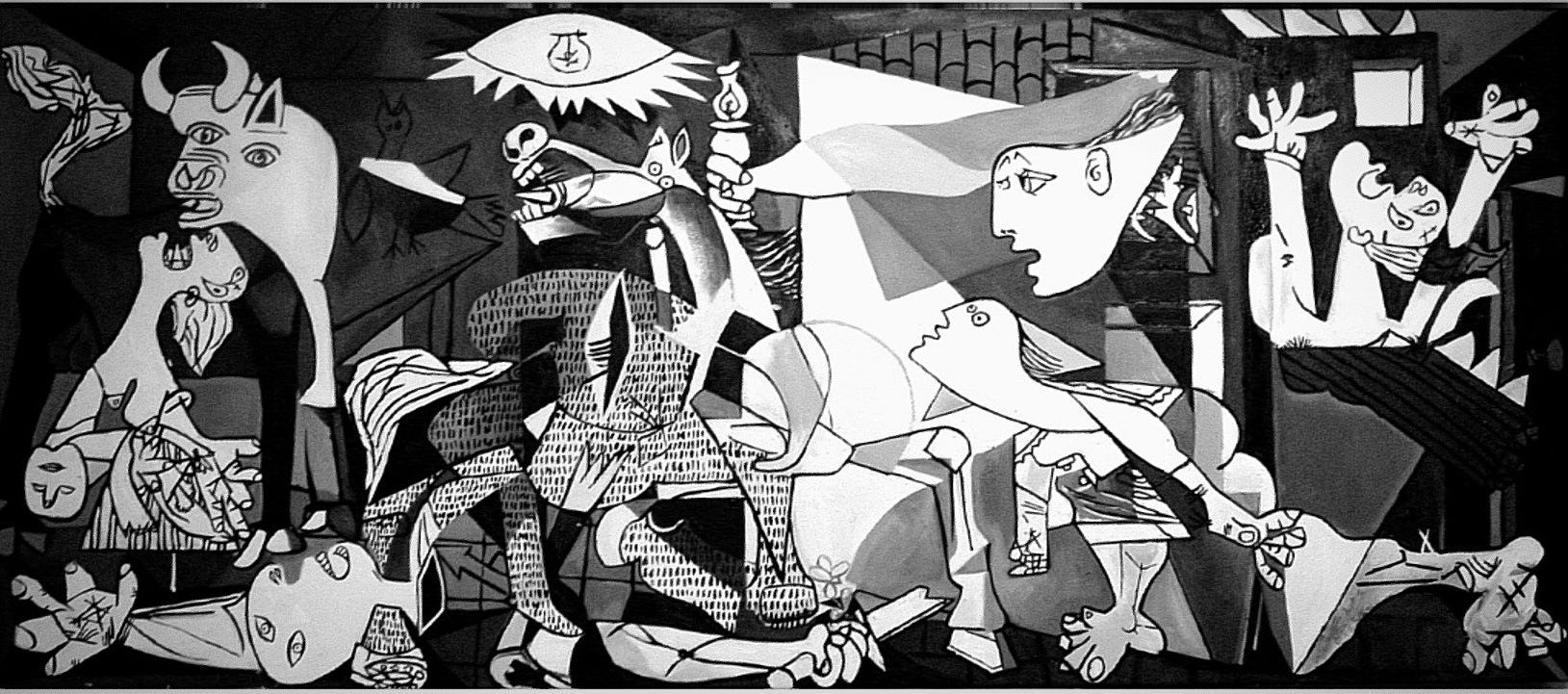
But Guernica does far more than show war’s destruction**.**The mural does not merely document suffering; it accuses those responsible for it. Its power lies not in what it shows, but in what it says without words. The painting protests the barbarity of war with such force that even decades later its message remained politically uncomfortable. Guernica does not just represent an air raid; it deplores and denounces it.
In 2003 a tapestry reproduction of Guernica, displayed outside the Security Council chamber at the United Nations headquarters in New York, was reportedly covered up by officials during the US Secretary of State Colin Powell’s presentation advocating for the invasion of Iraq. Whether symbolic or practical, the gesture revealed something deeper. Picasso’s anti-war messages had the ability to disrupt political narratives because its imagery invited comparisons that the Bush administration and UN officials preferred the public not to make.
I often think about Guernica these days. Perhaps because the painting no longer feels like a historical artefact from another century but an enduring portrait of the world we continue to inhabit. Picasso painted the terror of civilians trapped beneath falling bombs, and nearly ninety years later we continue to watch similar scenes unfold across Ukraine, Gaza, Iran, and Lebanon. Families searching through rubble, children carried from destroyed buildings, entire neighbourhoods erased within minutes. The technology has evolved, the rhetoric has changed, but the suffering remains unchanged.
What troubles me most is not only the repetition of violence but the growing sense of helplessness surrounding it. How does one meaningfully protest such destruction today? Public demonstrations are increasingly dismissed, politicised, or even criminalised. Social media, once hailed as a democratic public square, now feels pointless at best and dangerous at worst. Outrage circulates endlessly, yet nothing seems able to slow the machinery of war.
Could another Guernica still shake the conscience of the world?
Part of me wants to believe it could. I want to believe art still has the power to confront cruelty and make people see what politics try to hide. But another part of me, perhaps the largest one, suspects that we are living through an age in which even the most powerful images are swallowed by the endless noise of modern life, unable to penetrate the indifference of dictators, opportunists, and leaders intoxicated by power.
And perhaps that is the most unsettling thought of all.
Thanks for reading Chronicles of a Liquid Society! This post is public so feel free to share it.
✍️ Written by

Newsletter
Stay updated with new articles.
No comments yet. Be the first to comment!