

Ten shopworkers, seven grapefruits, and one strike that challenged the apartheid
It all began in Dublin in July 1984, in an ordinary branch of Dunnes Stores on Henry Street, a retail chain known for selling basic foodstuffs, clothing, and household wares—a place that no one would have imagined could play a role in reshaping global politics.
On the morning of 19 July, twenty-one-year-old shop assistant Mary Manning probably did not wake thinking that that day she would find herself confronting the brutal machinery of apartheid from halfway across the world. And yet, that is precisely what happened.
It was the era of apartheid in South Africa, when a white minority controlled the country and brutally oppressed the black majority through systemic and institutionalized racism. That morning, Mary read that her union, the Irish supermarket and department store workers’ union, IDATU, had issued directions to its members not to handle South African produce in protest of apartheid policies. She decided to take a stand.
Mary announced to the Dunnes store management that she would no longer touch products from South Africa, protesting against the apartheid regime. “Come to your senses, girl,” they told her. “We only have one product from South Africa: these seven grapefruits. What kind of protest is this? Get back to work and stop this nonsense.”
Mary Manning stood her ground. She refused to be swayed, and when her colleague and friend Karen Geron joined her in solidarity, also refusing to touch the seven grapefruits, the management fired them both.
That should have been the end of it, but when the union members at Dunnes heard the story, they were outraged and went on strike in protest. It was a small strike, ten people in all, mostly young women with no prior political engagement. They protested outside the store not only for Mary and Karen but also for the suffering people of South Africa, acting on the belief that injustice somewhere is still injustice everywhere.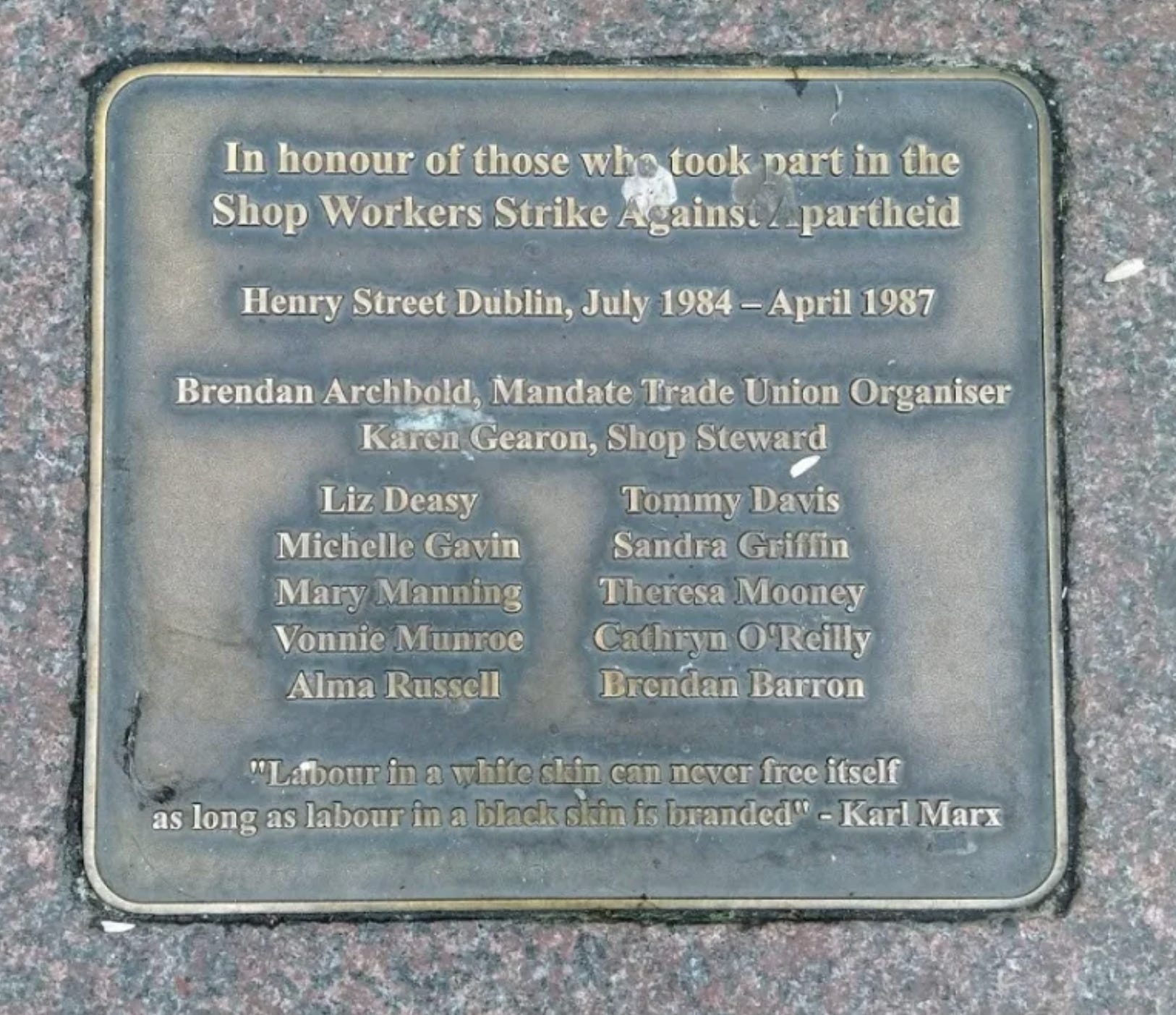
Days passed, and the strike continued. The store had no desire and no incentive to back down. People were largely indifferent. Ireland had its own problems: unemployment, housing shortages, political turmoil. Who had time for a handful of shop assistants protesting a regime on the other side of the planet? Days turned into weeks.
Then one day, a visitor arrived who would change the story. Nimrod Sekeramane Sejake, a prominent South African trade union leader and anti-apartheid activist who had spent decades in exile in Ireland, joined them on the picket line, lending his personal testimony to their protest. Even so, the rest of the world remained largely indifferent. Weeks turned into months. The store did not budge, passersby rolled their eyes, and the picket line became a curiosity, then a nuisance.
But then someone else noticed the women: the Reverend Desmond Tutu, Archbishop of Cape Town and moral giant. On his way to Oslo to receive the Nobel Peace Prize, Tutu stopped in Dublin to meet the young protesters. Photos were taken, articles were written, and suddenly this tiny protest was in the spotlight.
Tutu invited them to South Africa. Some of the women scraped together the money and went, only to be arrested upon arrival, placed on a plane, and sent back. The incident became a public relations disaster for the apartheid regime, and the “grapefruit strike” made international headlines.
What had begun as a handful of shop assistants refusing to touch seven grapefruits had escalated into a movement with global resonance. The young protesters, once seen as curious but unimportant, became something else: notorious. Their story reached across the Atlantic to another man who took notice: Jesse Jackson, who declared that if these women could stand up for strangers halfway around the world, so could he. He joined them on the picket line.
Now no one could ignore what was happening. Pressure mounted, Dunnes Stores relented, and stopped selling South African produce. The strike lasted until 1987, when the Irish government went further, becoming the first Western country to impose a total ban on apartheid-era South African goods.
Then someone else learned their story—a man who knew exactly what apartheid meant: Nelson Mandela. Upon his release from prison in 1990, he traveled to Dublin to meet Mary, Karen, and the other protesters, acknowledging their small but meaningful role in the global anti-apartheid movement.
Nimrod, who had ended up in Ireland as a refugee hunted by the regime, returned to South Africa and continued his activism, advocating for compensation for lands seized under apartheid and working with unions to improve conditions for workers. Nelson Mandela became president, and when he died, the young people who had started with a strike over seven grapefruits were invited to his funeral, standing as representatives of Ireland.
Today, there is a Mary Manning Street in Johannesburg, commemorating the legacy of one young woman’s insistence on doing the right thing.
The moral of the story is simple: persistence matters, courage matters, and sometimes the path to changing the world begins with refusing to touch seven grapefruits.
Thanks for reading Chronicles of a Liquid Society! This post is public so feel free to share it.
✍️ Written by

Newsletter
Stay updated with new articles.
No comments yet. Be the first to comment!