

The Mephistophelean Bargain of Power
Could one day future generations look at our extractive habits, the environmental devastation, the coerced labour, and casual disposability of human lives, and judge us with the same moral clarity that we now apply to slavery?
When you tap our screen, stream a video, or send a message across the world, do you ever stop to consider the origins of the elements inside your device that made this possible, the metals extracted from ancient rock, the minerals forged in the collapse of stars, and the materials extracted through immense human struggle and planetary cost?
This is precisely the question Nicolas Niarchos set out to confront. For years, he followed the people, corporations, and the processes that together form the hidden infrastructure of modern life. In his book The Elements of Power: A Story of War, Technology, and the Dirtiest Supply Chain on Earth , he reveals how the promises of digital convenience and clean energy rest on foundations of environmental devastation, human exploitation, and suffering pushed out of sight in favour of a vision of a developed world.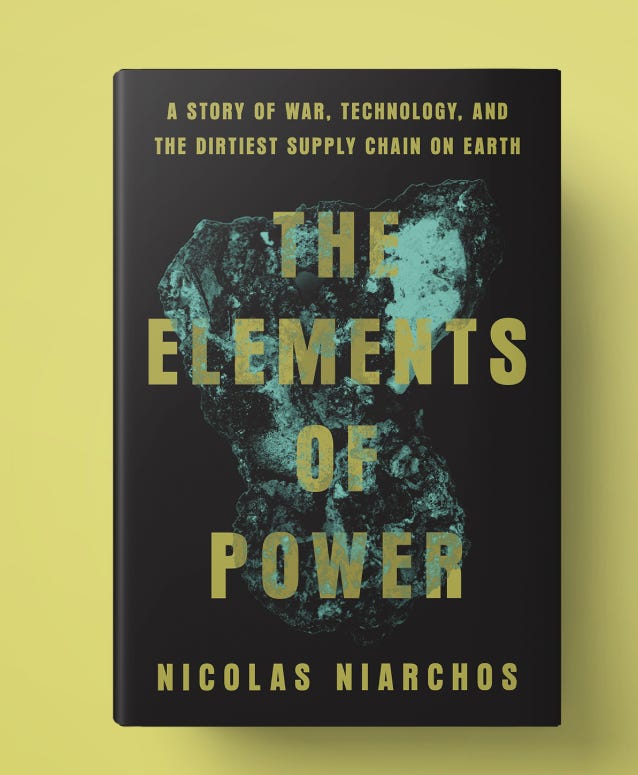
Niarchos frames this arrangement as a modern Mephistophelian bargain, one in which batteries and the technologies they enable bind us to a global economy, that accepts devastation so long as it remains geographically and morally distant.
Tracing the path of lithium, cobalt, nickel, and other critical materials, Niarchos moves from the mining pits of southern Congo to industrial zones in Indonesia and across a web of extraction sites that power everything from smartphones to electric vehicles. What he exposes is an energy transition built on structural inequality, where poisoned water, devastated landscapes, dangerous artisanal mining, and abusive labour practices are not treated as scandals to be resolved but as inevitable externalities absorbed by the world’s poorest communities. As demand for these materials accelerates, the widening gap between supply and need has become one of the defining economic pressures of our time.
At the beginning of the twenty-first century, a transformation took place in both the motivation and the attitude toward metal extraction, a shift that reshaped the global geopolitical order. During the Cold War, U.S. corporate interests were often aligned - at least rhetorically - with the expansion of the American middle class and the support of non-Soviet governments abroad. Today, shareholder value has replaced any remaining sense of patriotic duty. While the United States only became serious about securing critical minerals in the early 2020s, China had already invested heavily across Africa and South Asia, securing access to rare metals with little concern for pollution, corruption, or the destruction of local communities. Even remote and resource-rich regions like Greenland have become arenas in this intensifying competition.
Niarchos also examines the competing technological visions shaping the future of energy storage, from incremental improvements in battery chemistry, such as silicon-based anodes to boost energy density to more ambitious breakthroughs that promise radical transformation. Yet he remains sceptical that innovation alone can resolve the ethical and environmental contradictions at the heart of battery power, arguing that without structural change, the same harms will simply be reproduced on a larger scale. Meeting climate goals, he suggests, will require not only massive investment in cleaner mining practices, but also an honest reckoning with the damage already done.
As demand for rare metals accelerates across electronics, defence, and green technologies, the pressure to secure supply increasingly drives extraction under abusive conditions and even emboldens powerful states to intimidate and pressure weaker ones. Theopacity of global supply chains allows exploitation to remain hidden and makes it difficult for companies to guarantee “clean” sourcing.
While reading, I found myself imagining my grandson one day asking me
- How could you justify poisoning entire regions for the sake of electronics and batteries?
- How could you tolerate forced labour in mineral supply chains while claiming to value human rights?
- How could you accept environmental destruction on a scale that permanently reshaped the planet?
I am still trying to find an answer.
What about you?
Thanks for reading Chronicles of a Liquid Society! This post is public so feel free to share it.
✍️ Written by

Newsletter
Stay updated with new articles.
No comments yet. Be the first to comment!