

What Comes After Extinction
There is something slightly disquieting about reading a headline announcing that a chicken has been hatched inside a 3D-printed shell. Not because it sounds extraordinary, which it does, but because of what it is pointing toward. A future in which extinction may no longer be the irreversible boundary we believed it to be.
There is no doubt that the frontier of de‑extinction — or species re‑creation — is accelerating rapidly, driven not only by technical audacity but by the profound philosophical and bioethical questions it forces us to confront. Few developments illustrate this ambition more clearly thanColossal Biosciences, which has increasingly positioned itself at the vanguard of species revival.
Colossal recently announced that 26 live chicks had been successfully hatched using an artificial eggshell, a lattice-like structure lined with a bioengineered silicone membrane designed to mimic the gas‑exchange properties of a natural shell. At first glance the experiment may sound almost trivial, until one remembers how astonishingly sophisticated an ordinary eggshell actually is. Natural eggshells, though only about 0.4 millimeters thick, perform a remarkably complex set of biological functions: they regulate oxygen and carbon dioxide, block pathogens, and supply calcium to the developing embryo. Evolution refined that system over hundreds of millions of years. Colossal built a working substitute in a laboratory in what … a few years?
To be precise, Colossal’s engineered system replicates only part of this architecture, specifically the rigid shell and oxygen‑permeable membrane. Researchers still have to supply the yolk, albumen, and calcium manually, which is why many biologists are right to call this an artificial eggshell rather than a synthetic egg.
The distinction matters, but it does not diminish what has been accomplished. Because the real target is not the chicken. It is the South Island giant moa of New Zealand, an enormous flightless bird whose eggs were roughly 80 times the volume of a chicken egg. No living bird could lay one, or brood one. If you want to bring back a moa, you need to build the cradle first.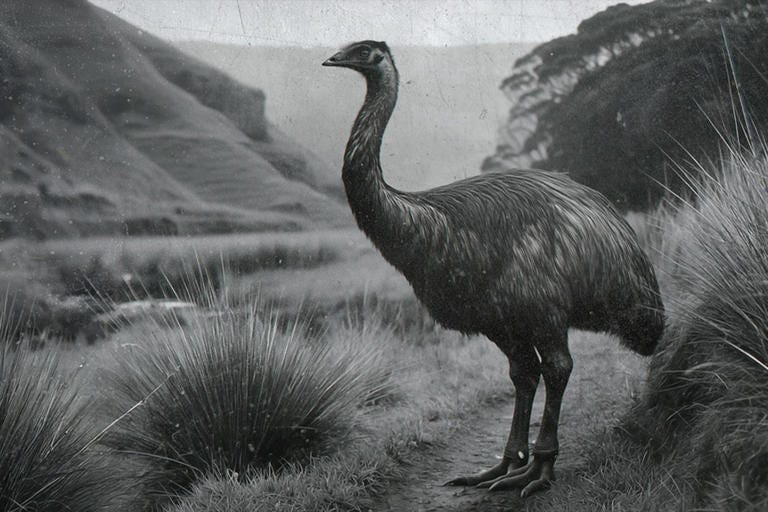
Colossal argues that artificial incubation systems of this kind are essential for any credible attempt at avian de‑extinction, since no modern surrogate species exists that could gestate eggs of that scale. The company has already pursued similarly controversial projects involving extinct mammals, including the engineering of wolf pups modelled on the prehistoric dire wolf, which vanished roughly 12,000 years ago.
Whether these technologies will ever amount to true de‑extinction is still debated within evolutionary biology. Many researchers argue, that producing genetically modified approximations is not the same as restoring an extinct species. DNA alone cannot fully restore, the ecological role, the behaviour, or the countless subtle refinements accumulated across millennia of natural selection. An organism may resemble what was lost without ever truly becoming it.
Yet even critics acknowledge that the technologies emerging from these experiments matter far beyond the symbolic resurrection of a single species. Artificial incubation systems, advanced gene editing, and cross‑species developmental biology, may have transformative implications for conservation, developmental science, even about our understanding of life’s boundaries.
There is also a philosophical weight to all of this that the science alone cannot resolve. Human history is in many ways a history of erasure. The idea that some of that might be reversible, however imperfectly, forces an uncomfortable confrontation with responsibility, not only technological responsibility but moral responsibility.
For centuries extinction represented a final sentence written by nature or by us. Now, for the first time, that finality appears less certain. That is worth paying attention to.
Thanks for reading Chronicles of a Liquid Society! This post is public so feel free to share it.
✍️ Written by

Newsletter
Stay updated with new articles.
No comments yet. Be the first to comment!