

What the Loop Teaches Us: Time, Existence, and the World We Consume
Time is fake, and it is the realest thing there is. So begins Joanna Biggs’s reflection on Solvej Balle’s extraordinary septology,On the Calculation of Volume , in London Review of Books , and it’s hard to imagine a better opening for a novel built entirely on this paradox.
Balle’s protagonist, Tara, is trapped in a repeating 18th of November. Literally. Her husband Thomas wakes each morning convinced it is the same autumnal Tuesday. She, meanwhile, has lived the day a thousand times. The difference between those two experiences holds most of what philosophy has ever argued about time, and much of what ecology says about how humans use up the world.
There are, broadly speaking, two ancient positions on time. There is the Newtonian “container” theory, where time exists independently of events, flowing uniformly whether or not anything happens. And there’s the Aristotelian relational view of time, which says that without events, without change, there simply is no time, only silence and nothing. Balle isn’t interested in resolving this so much as staging it and letting the reader sit inside it. Not in a lecture room, but across a long, repetitive November day.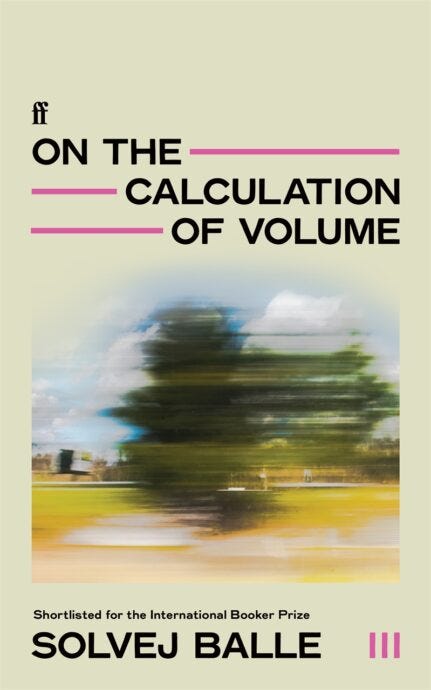
Tara, and a small number of others like her, age. They accumulate, they consume. They cut their hair, mark the days, carry memory like a private archive. The rest of the world resets at midnight. They live fully, convincingly, but without residue. Time passes through them without sticking.
Tara’s situation is less Groundhog Day and more watching late‑stage dementia from the outside, she’s the one who remembers, and everyone else is the one slipping away. This raises a difficult question. How does being the only one who remembers reshape her relationships? Each person is an individual with their own life, their own pain, and their own moral claim on us. Harm done to one person matters because it is theirs.
Butif harm leaves no trace - no memory, no consequence—does it still count*?* A person harmed is a person who carries that harm forward. But what if they don’t? Tara can disappear for months*.*For Thomas, nothing has happened. For Tara, everything has.
And then there is the matter of consumption. One of the darker, stranger questions -at least for me - is this: what is Tara doing to the world? Each day, Tara eats, buys, uses. Each loaf of bread she takes from the supermarket is still gone the next day, not for her, but from shelves restocked for billions who believe the world is carrying on normally. Tara alone experiences the depletion accumulating across repetitions. She describes herself, with unsettling clarity, as a monster devouring the world.
It’s funny in a dark way, imagine trying to explain to a shopkeeper that you’ve eaten their entire apple inventory across a thousand Tuesdays. But the joke has a sharp side. Because the depletion doesn’t disappear. It just becomes unevenly visible.
Leibniz argued that space is not a substance or a container but an order of coexisting things — a network of relations. Without objects, space itself would not exist. Balle’s novel hints at something similar. If a small group continues to consume long enough without reset, they risk not just emptying shops but unravelling the physical fabric of the world.
There’s an environmental parable here that Balle never really spells out but it surfaces anyway. A small group of people, insulated from consequences, drawing down a shared world. The unsettling part is how little anyone notices. The shopkeeper comes in on day one thousand to find no apples, frowns, orders more, and thinks nothing further of it. Sound familiar?
What’s remarkable is how Balle manages all this without turning the book into an argument. Each book is an idea‑driven novel, but Balle never pauses the story to say, in effect, “I am now making a point.” She leaves the thinking to us, and that’s part of what makes the books so compelling.
On the Calculation of Volume is, in the end, a novel about time, memory, and what it means to live inside a world that keeps slipping away. I look forward to the next four volumes. While we wait, let’s not suggest that time isn’t real because it doesn’t matter. After all, if time is both unreal and unavoidable, the only sensible response is to keep going, and see what remains.
Thanks for reading Chronicles of a Liquid Society! This post is public so feel free to share it.
✍️ Written by

Newsletter
Stay updated with new articles.
No comments yet. Be the first to comment!