

When Language Turns Against Us
I will start by saying that Basilisk is a strange book, and that strangeness is exactly what makes it so compelling.
Matt Wixey constructed Basilisk as an academic reconstruction of an unedited document, received online. Its narrative is buried within fragments such as data dumps, email chains, and bibliographies, and even a cryptic crossword. The Helmsman Texts, which interrupt the main story, move through Plato’s Allegory of the Cave, theories of subliminal influence, and the idea that language could function as a virus. What emerges is less a traditional horror novel and more an attempt to rethink what horror can look like in a networked world.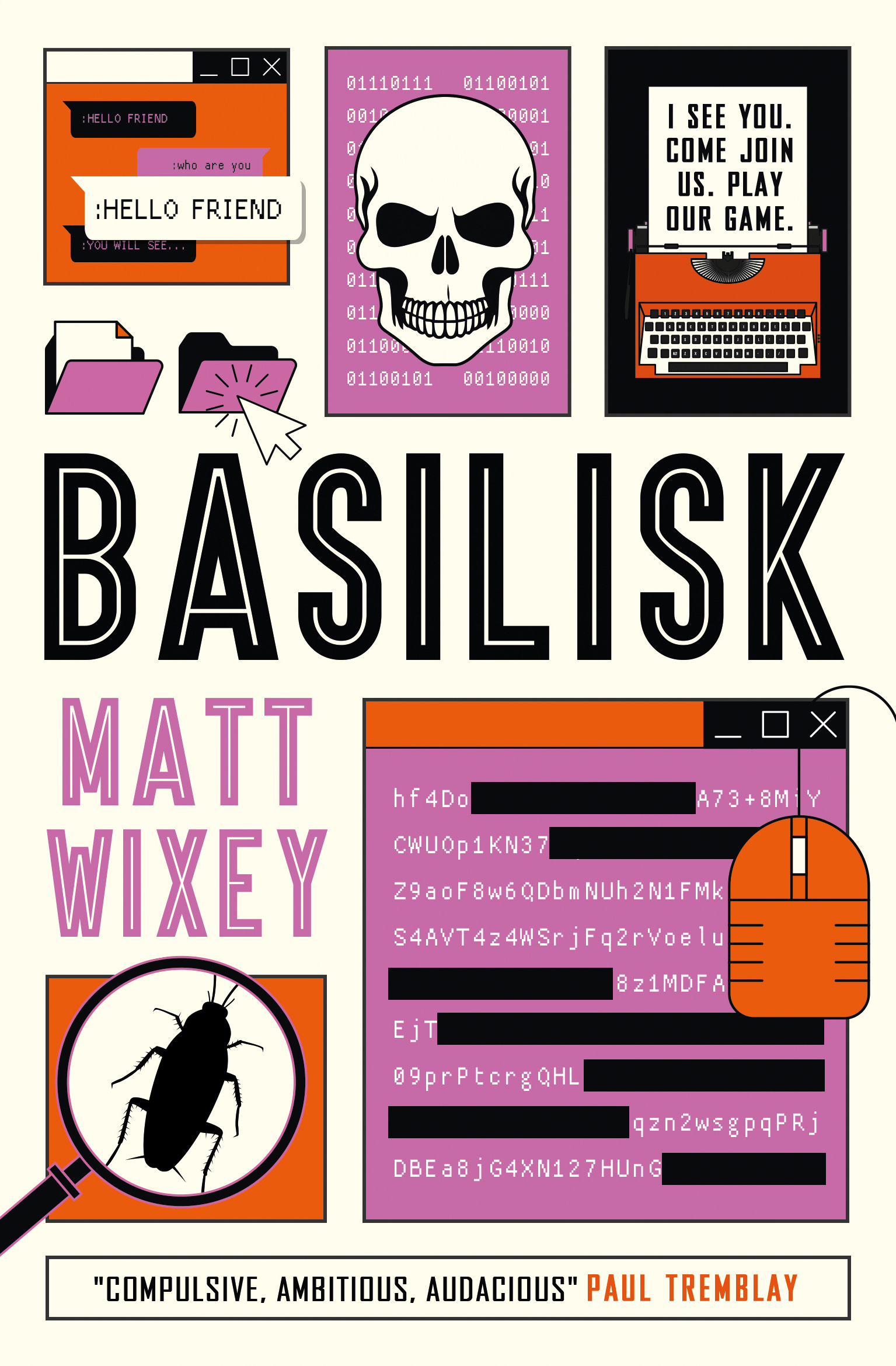
Now, others will reach immediately forHouse of Leaves . The comparison is not wrong, but, while I was reading, I found myself thinking of something older and stranger. Thomas Ligotti, perhaps. This is horror that is philosophically infected, where terror does not live in a monster, but in the idea of the monster. It takes shape within the mind rather than outside it.
Because what Wixey has conceived is a basilisk, not the legendary supernatural creature whose gaze or breath can kill instantly, but something far more abstract and unsettling. A sequence of four words, arranged with such precision that they can scramble a human mind. A weapon made entirely of language. Which raises the obvious question: wasn’t literature always a little dangerous, for those willing to engage with it fully.
The story follows Alexandra Webster, an ethical hacker drawn into a mysterious online game that conceals something far more dangerous. A cyber weapon designed not to target machines, but to destabilise people - to make them go insane. The thriller elements are present, but I must confess they interest me less than what the book is really saying about the self. About how porous and vulnerable we have become.
Drawing on ideas such as Roko’s Basilisk and the cultural phenomenon of Slender Man, old English, and philosophy, the novel is built around a single argument: that ideas, once released into the online world, can become something far more dangerous than anyone first imagined.
This is an unusual book, one that demands attention, patience, and active engagement to get through. You can begin it again and discover, even in the first few pages, things you entirely missed the first time. For readers who enjoy putting effort into making meaning, this is very much part of its appeal.
Basically, Basilisk is about fear. Not the fear of monsters, but the fear that the digital world made us vulnerable to forces we cannot easily see or name. That an idea, carefully constructed, might reach through a screen and alter who you fundamentally are. As such it feels like a warning disguised as a puzzle, disguised as a work of fiction. In its own unusual way, it is a rather beautiful one.
Thanks for reading Chronicles of a Liquid Society! This post is public so feel free to share it.
✍️ Written by

Newsletter
Stay updated with new articles.
No comments yet. Be the first to comment!